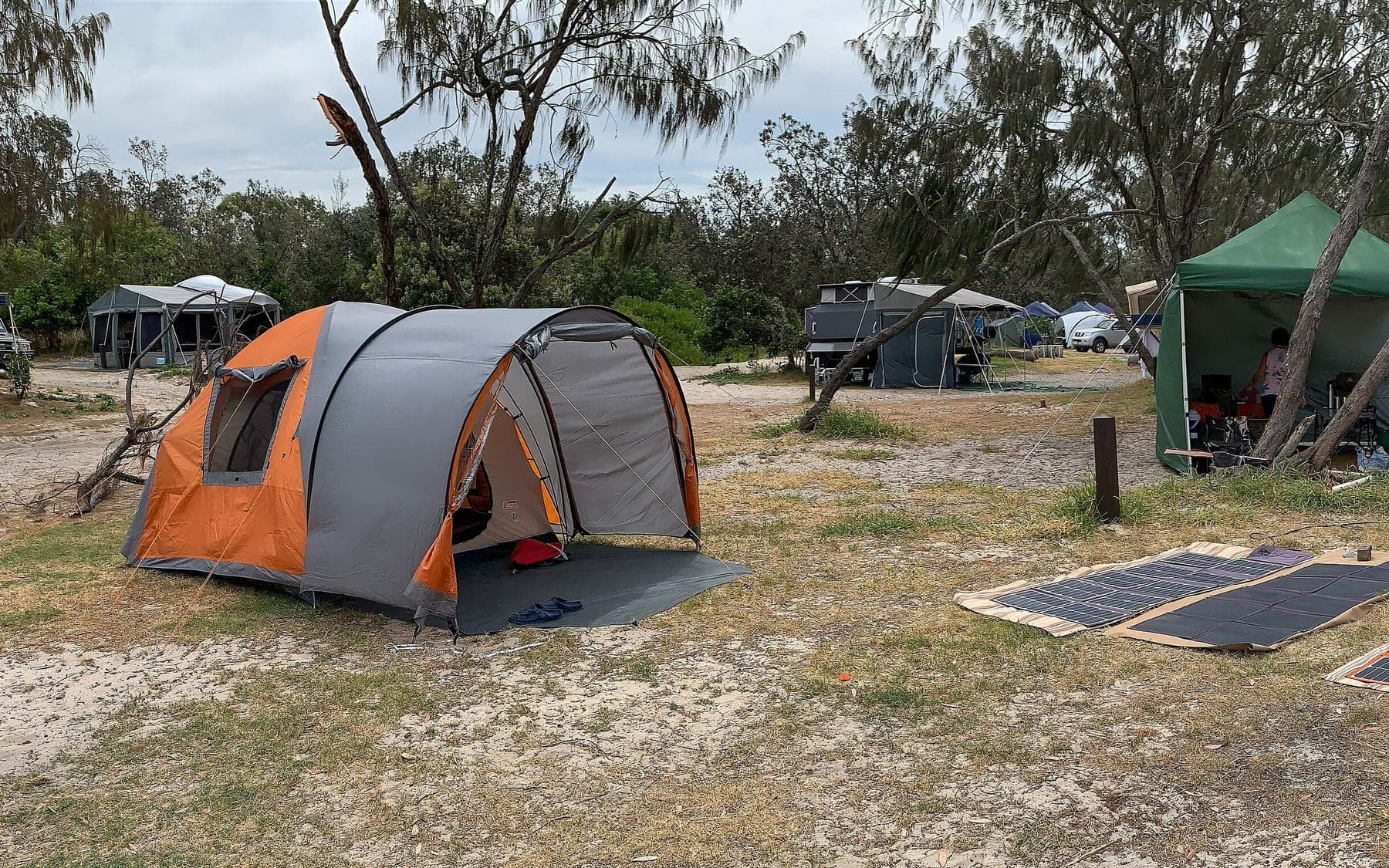
Rooftop tents, swags and ground tents compared
Photo by Stephan Ridgway from Brisbane, Australia · Wikimedia Commons · CC BY 2.0
- Section
- Gear
- Category
- Camp setup
- Read
- 4 min
- Updated
- 24 Aug 2026
Three ways to sleep in the bush, each with a real cost that the marketing tends to skip.
There is no correct answer here, only a correct answer for how you travel. The question that decides it is not comfort. It is how often you move camp, and whether you want to leave the vehicle behind when you get there.
Swags
A swag is a canvas bedroll with a mattress built in. It is the traditional Australian answer and it remains the best one for a certain kind of trip.
What is good. Setup is measured in seconds. It is warm, it is genuinely tough, and the canvas breathes in a way that synthetic tent fabric does not, so condensation is much less of a problem. It rolls up and lives in the back without much thought. There is nothing to break.
What is not. It is heavy and bulky for what it sleeps. Sitting up in one is not really possible, so in sustained rain you are lying down for the duration. Ventilation in genuine heat is limited. It is a one-person proposition in practice, doubles notwithstanding.
Right for: solo and pair travel, frequent moves, dry season touring, anyone who values setup time over living space.
Rooftop tents
A folding tent mounted on the vehicle's roof or a rack, deployed by unclipping a cover and folding it out, usually over a ladder.
What is good. Off the ground, which matters where the ground is wet, rocky, sloping or has things living in it. Setup is quick. The mattress is generally better than anything you will put under a ground tent. The footprint is the vehicle's footprint, which is useful on small or hard sites.
What is not, and this is the big one. Your bed is attached to your vehicle. To go anywhere, you pack up camp. For a touring style where you set up and use the vehicle for day trips, that is a daily tax that gets old fast.
Beyond that: significant weight high on the roof, which affects handling on exactly the terrain where handling matters. It eats roof rack capacity that could carry other things. Wind noise and fuel use go up permanently, not just when camping. Getting down the ladder at three in the morning in the rain is exactly as unappealing as it sounds. And they are expensive.
Right for: touring where you move most days, wet or rough ground, people who want quick setup and will pay for it in fuel and roof space.
Ground tents
The conventional option, and the one that gets dismissed too quickly.
What is good. Cheapest by a wide margin. Lightest. Space per dollar is unmatched, and a family-sized ground tent costs a fraction of a two-person rooftop. The vehicle stays free: set up camp, drive off for the day, come back. Choose your pitch rather than parking on it.
What is not. Slowest to set up, particularly the larger ones. You need reasonably flat, clear ground. Condensation is more of an issue. Cheap ones fail, and they fail in weather.
Right for: base camping, families, anyone who wants the vehicle available during the day, anyone on a budget.
The comparison that matters
| Setup time | Vehicle free during day | Weight penalty | Cost | Ground needed | |
|---|---|---|---|---|---|
| Swag | Seconds | Yes | Low, inside | Low | Minimal |
| Rooftop tent | A minute or two | No | High, on roof | High | None |
| Ground tent | Several minutes | Yes | Low, inside | Lowest | Flat and clear |
The question to ask yourself
How often do you move camp?
If you move most days, a rooftop tent's setup speed is a real daily benefit and the packing-up-to-drive problem never arises, because you were packing up anyway.
If you set up for three or four days and use the vehicle to explore, a rooftop tent is actively working against you and a ground tent is better in every respect that matters.
If you are travelling light, alone or as a pair, through dry country, a swag is hard to beat and always has been.
A note on what actually keeps you warm
Whatever you sleep in, the insulation underneath you matters more than the walls around you. Cold ground conducts heat out of you far faster than cold air convects it.
This is the most common mistake in Australian camping, because people plan for the daytime temperature they experienced. Inland Australia swings hard: a twenty-eight degree day in the Red Centre can be followed by a night below zero. The sleeping mat's insulation rating deserves at least as much attention as the sleeping bag's.
One practical note if you are leaning toward a rooftop tent: the rack matters as much as the tent. A rooftop tent puts a sustained dynamic load high on the vehicle, and the rack has to be rated for it both stationary and moving, which are different numbers. All Bars (opens in a new tab) make racks and cab-over racks to vehicle-specific fitments, and getting the rack rating confirmed before you buy the tent is the right order to do it in.
Related
Gear5 min read
Swags: what they are, and how to choose one
The canvas bedroll that defines Australian camping. What separates a single from a double, why stretcher models exist, and what actually matters when you buy.
 Gear
4 min read
Building a camp kitchen you will actually use
The setup that survives contact with a real trip, and the expensive gear that mostly stays in the drawer.
 Gear
4 min read
12V fridges: sizing, running costs and what actually matters
Compressor versus thermoelectric, how much power one really draws, and why the fridge decides the rest of your electrical system.