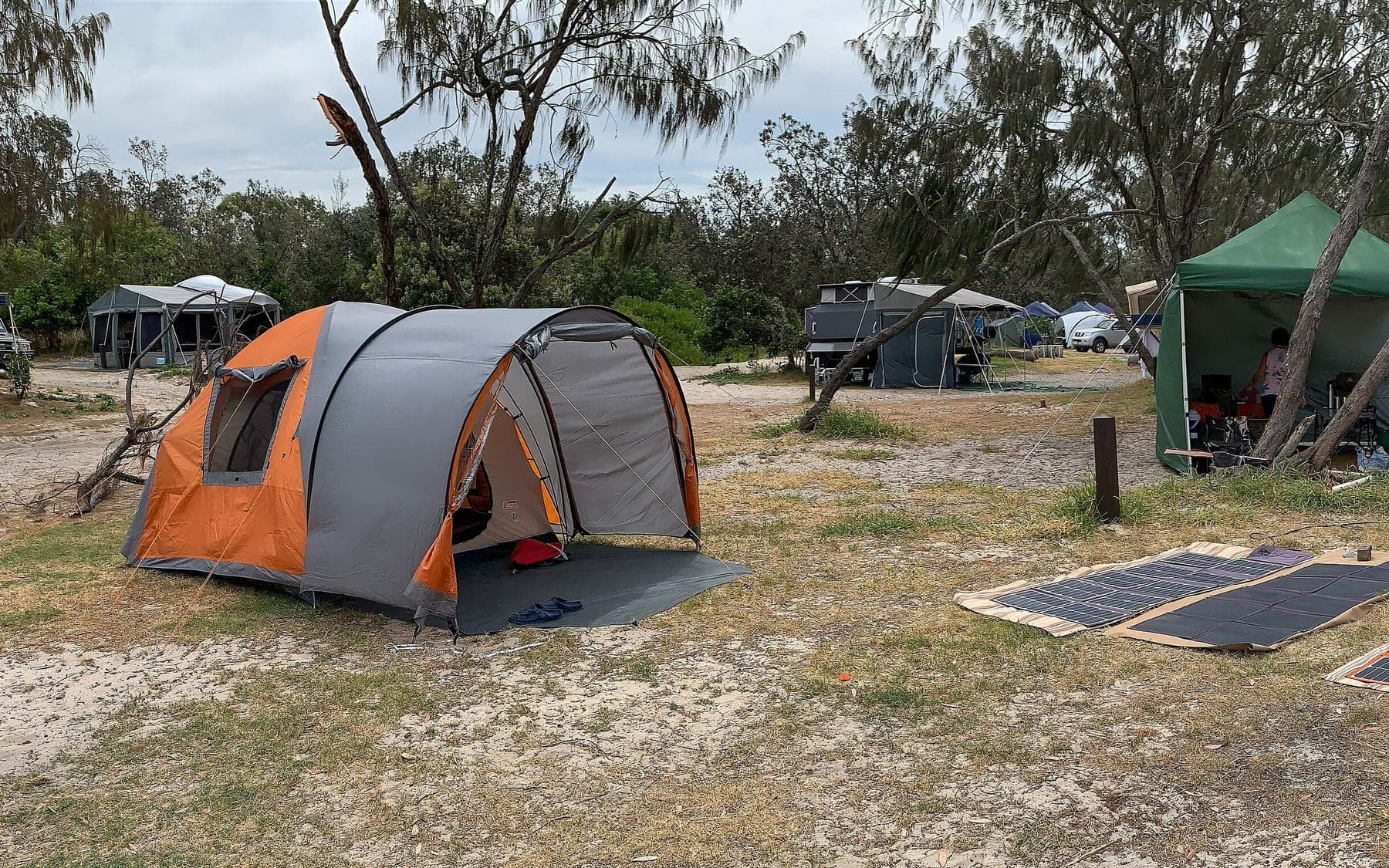
Swags: what they are, and how to choose one
Photo by Stephan Ridgway from Brisbane, Australia · Wikimedia Commons · CC BY 2.0
- Section
- Gear
- Category
- Camp setup
- Read
- 5 min
- Updated
- 27 Aug 2026
The canvas bedroll that defines Australian camping. What separates a single from a double, why stretcher models exist, and what actually matters when you buy.
The swag is the piece of gear that most defines Australian camping, and it is one of the few things in this space where the traditional Australian answer is still genuinely the best one for a lot of trips.
At its simplest a swag is a canvas bedroll with a mattress inside. You unclip the straps, roll it out, and it is made. There is no pitching, no poles to thread, no pegs unless it is windy.
Why canvas still wins
Almost every other category of camping gear has moved to synthetic fabric, and swags mostly have not. That is not nostalgia.
Canvas breathes. Moisture from your body passes through the fabric instead of condensing on the inside of it, which is the single most common complaint about sleeping in a small nylon tent. Wake up in a cheap dome tent on a cold morning and the inner surface will be wet. In a swag it generally is not.
Canvas is also tolerant of the things that destroy synthetic fabric: dragging over gravel, sparks from a fire, being packed damp for a day, sitting in the sun for a week. A good swag lasts decades.
The trade is weight and bulk. A double swag is a substantial object, and it is heavier than a two-person tent that sleeps the same number.
Single, double, and why people buy the bigger one
Single swags run roughly 75 to 90cm wide. They sleep one adult comfortably and pack down to something one person can carry and throw in the back without thinking about it.
Double swags are roughly 120 to 150cm. They sleep two, and a great many are bought by solo campers who want the extra room for their gear, their dog, or simply to not touch canvas on both sides.
That second point is worth taking seriously before you buy. A double swag is not twice the swag. It is roughly twice the weight, it takes a much larger flat patch of ground, and on a small or rocky campsite that becomes the constraint that decides where you sleep.
Stretcher swags
A stretcher swag has a folding frame that lifts the whole thing off the ground, usually 30 to 40cm.
What that buys you is real. You are off wet ground, off uneven ground, away from most crawling things, and getting in and out is easier on the knees. It also creates storage space underneath, which matters when the swag is your entire bedroom.
What it costs is setup time and pack size. A stretcher swag is no longer a thirty-second job, and it is a much bigger object in the vehicle. For touring where you move most days, that daily cost adds up quickly. For a base camp you will occupy for a week, it is close to ideal.
What actually matters when buying
Canvas weight, measured in ounces or grams per square metre. Heavier canvas is more durable and more weatherproof, and it is heavier to carry and slower to dry. Most touring swags sit in a sensible middle ground; very light canvas is a false economy.
The floor. Look for a heavy-duty PVC or ripstop base that extends up the sides. This is the surface that takes the abrasion and stops ground moisture, and it is where cheap swags fail first.
Zips. The most common point of failure on any swag, and the one thing you cannot easily repair in the field. Heavy-gauge zips with storm flaps over them are worth paying for. Two-way zips let you vent the foot end without opening the whole thing.
Insect mesh that can be closed independently of the canvas, so you can sleep with mesh only on a warm night.
The mattress. Usually 50 to 70mm of foam. Adequate, and not the same thing as insulation. See below.
Head-end poles or hoops that keep the canvas off your face. A swag without them is a bivvy bag, and lying with wet canvas on your nose in the rain is a specific misery.
The insulation mistake
The most common error in Australian camping is packing for the daytime temperature.
Inland Australia swings hard. A day in the high twenties in the Red Centre can be followed by a night below freezing, and the ground is what takes your heat. Conduction into cold ground moves heat out of you far faster than cold air convects it away.
A swag's foam mattress is comfort, not insulation. If you are camping inland in winter, put a self-inflating mat with a real R-value inside the swag under you. It will do more for your night than a warmer sleeping bag will. This is covered further in rooftop tents, swags and ground tents compared.
Looking after it
Never roll it away wet. This is the whole of swag care in one line. Canvas holds moisture, mould establishes within days, and once it is in the fabric it marks permanently and eventually rots the fibres. If you must pack damp, unroll it the moment you are home.
Do not proof new canvas. Most modern swag canvas arrives treated. Weathering it, meaning wetting it thoroughly once and letting it dry before the first trip, helps the fibres swell and seal.
Store it loosely and somewhere dry, not compressed in a hot vehicle for six months.
Is a swag right for your trip
The question that decides it is how often you move.
Moving most days, one or two people, dry-season touring: a swag is very hard to beat, and the thirty-second setup at the end of a long drive is worth more than it sounds.
Staying put for days, or travelling as a family, or wanting to use the vehicle during the day: a ground tent gives you more space for less money and leaves the vehicle free.
The full comparison, including rooftop tents, is in rooftop tents, swags and ground tents compared. If you are heading somewhere remote, the packing that goes around it is in water: how much to carry.
Common questions
- What is a swag?
- A swag is a canvas bedroll with a built-in mattress, designed to be rolled out and slept in directly. Traditional swags were a simple canvas sheet wrapped around bedding. Modern versions add a frame, insect mesh and a zippered entry, so they function as a compact one-person tent that needs almost no setting up.
- Is a swag better than a tent?
- For one or two people moving camp often, usually yes. A swag sets up in seconds, handles wind and rain well, and the canvas breathes so condensation is far less of a problem. A tent wins when you need standing room, space for a family, or want to leave camp set up while you drive somewhere for the day.
- What is the difference between a single and a double swag?
- A single swag sleeps one adult and is typically around 75 to 90cm wide. A double is roughly 120 to 150cm and sleeps two, though many people buy a double to use alone for the extra room. A double is significantly heavier and bulkier, and it needs a larger flat patch of ground.
- Do you need a mattress in a swag?
- Most swags include a foam mattress, commonly 50 to 70mm. It is enough to sleep on but it is thin insulation, and cold ground pulls heat out of you far faster than cold air. In genuinely cold conditions, adding a self-inflating mat underneath makes more difference than a warmer sleeping bag.
- How do you stop a swag getting mouldy?
- Never roll it away damp. Canvas holds moisture and mould sets in within days, permanently marking the fabric and eventually rotting it. Air it fully before packing, and if you have to pack it wet, unroll it to dry the moment you get home.
Related
Gear4 min read
Rooftop tents, swags and ground tents compared
Three ways to sleep in the bush, each with a real cost that the marketing tends to skip.
 Gear
5 min read
Camping mattresses: R-value, thickness and what actually keeps you warm
Self-inflating, air and foam compared, why the insulation number matters more than the thickness, and how Australian conditions change the answer.
 Gear
4 min read
12V fridges: sizing, running costs and what actually matters
Compressor versus thermoelectric, how much power one really draws, and why the fridge decides the rest of your electrical system.