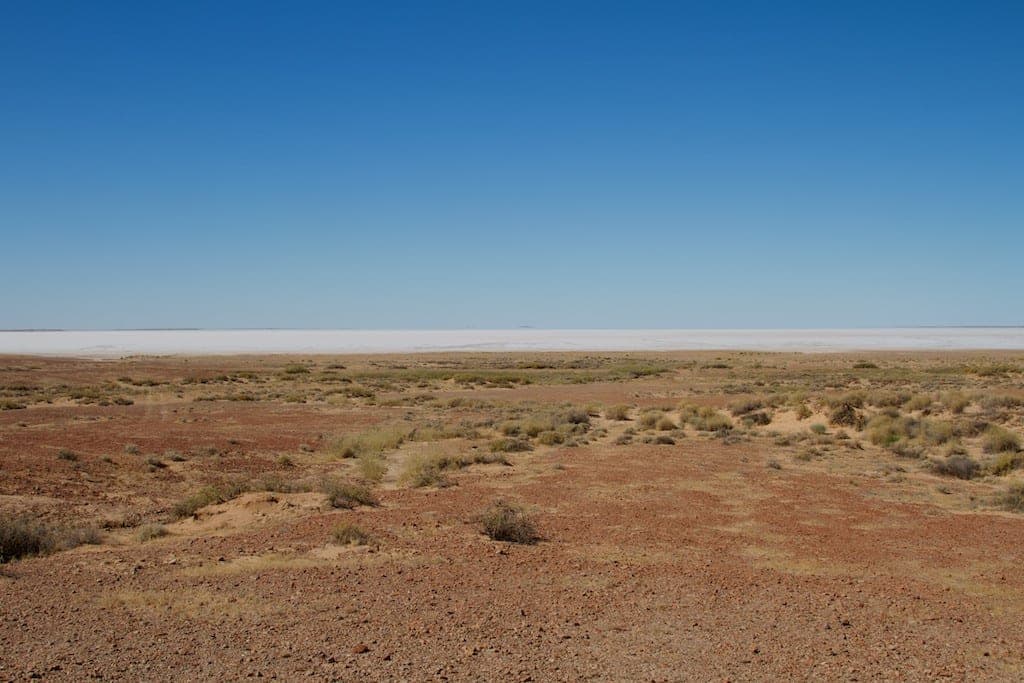
Water: how much to carry, and how to treat what you find
Photo by jfantenb · flickr · CC BY-SA 2.0
- Section
- Guides
- Category
- Planning
- Read
- 4 min
- Updated
- 12 Aug 2026
The one resource where running short changes from inconvenient to dangerous, and the arithmetic is not complicated.
Fuel planning gets all the attention because running out of it is embarrassing and expensive. Running out of water is the one that hurts you.
The arithmetic is straightforward, and the mistake people make is not the calculation. It is forgetting that drinking is only part of the demand.
The number
The commonly used planning figure for remote Australian travel is five litres per person per day, and in hot conditions that rises. Some references push to seven or more for sustained heat.
Five litres is not five litres of drinking water. It covers:
- Drinking, which is most of it
- Cooking and rehydrating food
- Washing up
- Basic personal washing
- The margin you did not plan for
Then you add a contingency on top of the whole trip. The usual advice is enough spare for two or three extra days beyond your intended duration, because the scenarios where you need water most are exactly the scenarios where you are not moving: a breakdown, a closed road, a flooded crossing.
For two people on a seven-day remote leg, that is roughly 70 litres of planned use plus 30 litres of contingency. A hundred litres is heavy and bulky, and that is the real constraint rather than the cost.
Carrying it
Split the storage. A single large tank is a single point of failure, and a split fitting or a cracked tank at the wrong moment takes all of it. Two or three separate containers means one failure costs you a fraction.
Secure it properly. Water is dense, and a 20-litre jerry is 20 kilograms travelling at the same speed as the vehicle. Unrestrained, in a rollover or a heavy stop, it becomes a projectile. This is one of the more common serious injuries in touring accidents and it is entirely preventable with proper restraint.
Think about where the weight sits. A hundred litres is a hundred kilograms. High up on a roof rack it does unpleasant things to the centre of gravity of an already tall vehicle. Low and central is the right answer.
Plastic tastes. New containers leach for a while. Fill, stand and dump a couple of times before a trip rather than discovering it on day one.
Treating what you find
Surface water in Australia is not safe to drink untreated, and the risks are not exotic. The common ones are protozoa such as Giardia and Cryptosporidium, bacteria including E. coli and Campylobacter, and downstream of agriculture, chemical contamination that no field treatment removes.
The three approaches each have a gap:
Boiling is the most reliable against biological contamination. Bringing water to a rolling boil is sufficient; sustained boiling wastes fuel. It does nothing for chemical contamination or sediment, and it costs fuel and time.
Filtering handles protozoa and bacteria if the pore size is fine enough, and it removes sediment, which matters for palatability. Most portable filters do not remove viruses. Filters clog, and dirty water clogs them fast, so pre-settle silty water before running it through.
Chemical treatment with chlorine dioxide or iodine handles bacteria and viruses well. Chlorine dioxide handles Cryptosporidium but needs a long contact time, sometimes hours, and the instructions on the packet are not padding. Iodine is not effective against Cryptosporidium and is not appropriate for long-term use or for pregnant travellers.
The robust approach for genuinely questionable water is filter first, then treat chemically. Filtering removes the sediment and the protozoa, treatment handles what got through.
Artesian water
Across a lot of inland Australia the available water is artesian bore water. It is usually safe in the microbiological sense, and it is frequently hot, heavily mineralised and unpleasant.
High mineral content is not something a standard filter fixes. Plan bore water as washing and cooling water, not as your drinking supply.
The habit worth building
Check the level, every day, at the same time.
Water disappears faster than people notice, because it goes in small amounts through the day rather than in obvious chunks. A daily check against a plan tells you on day three that you are running ahead of budget, which is when it is a scheduling adjustment. Discovering it on day six is a different conversation.
Related
 Guides
3 min read
Communications beyond mobile coverage
What actually works when the bars disappear, and why a mobile phone is not a safety plan.
 Guides
4 min read
Fire restrictions and campfires: how the rules actually work
Fire danger ratings, declared fire periods and total fire bans are three different things, and knowing which one applies decides whether you can light a fire tonight.
 Guides
4 min read
Free camping in Western Australia
The largest state, the longest distances, and a camping system where the constraint is not permission but fuel, water and how far apart everything is.