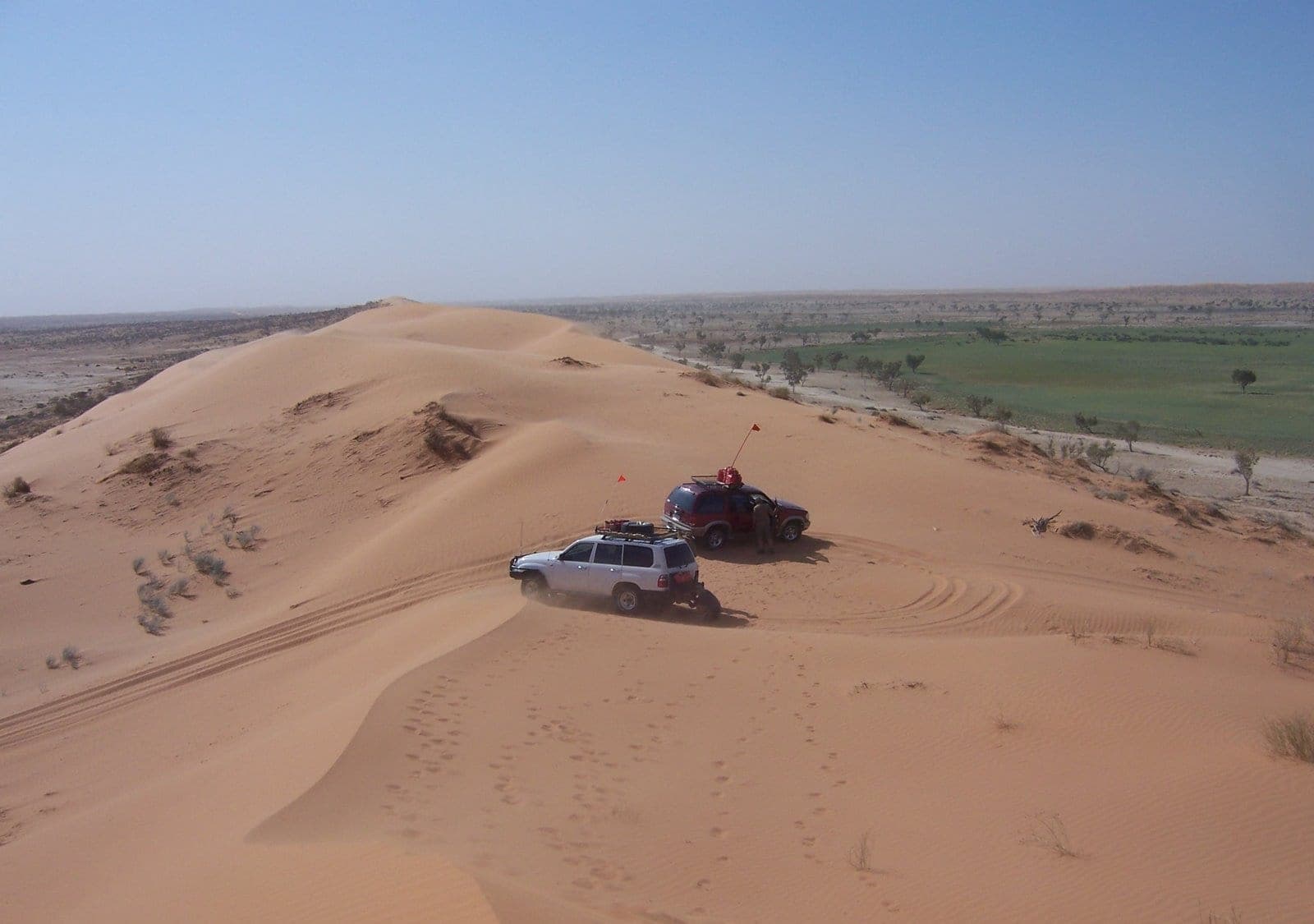
Communications beyond mobile coverage
Photo by User:Phanly (talk) · Wikimedia Commons · CC BY 3.0
- Section
- Guides
- Category
- Planning
- Read
- 3 min
- Updated
- 11 Aug 2026
What actually works when the bars disappear, and why a mobile phone is not a safety plan.
Mobile coverage in Australia follows the highways and the towns. Step off either and it stops, often abruptly and much closer to civilisation than people expect.
This matters because the standard mental model, that you can always call someone, quietly underpins a lot of trip planning that has no other backup.
What each option actually does
UHF CB radio is short range, line of sight, and free to use. It is the right tool for talking to the vehicle behind you, coordinating a convoy, calling ahead on a single-lane track, and hearing road trains before you meet them on a blind corner. Channel 40 is the road channel; 5 and 35 are reserved for emergencies.
What it is not is a way to reach help. Range in practical terrain is measured in kilometres, not tens of kilometres, and it depends entirely on someone being in range and listening.
Satellite messengers send text and position over a satellite network, usually with an SOS function routed to a coordination centre. They need a subscription and they work almost anywhere with a view of the sky. Modern units handle two-way text, which is the real advantage: you can describe the problem and receive a response rather than firing a flare and hoping.
Satellite phones give you voice. They are more expensive to buy and to run, and for most touring the messaging devices cover the need at a fraction of the cost. Where they earn their keep is extended remote work where you need conversation rather than messages.
Personal locator beacons are the emergency-only option. No subscription, no messaging, one function: when activated, transmit a distress signal and your position on 406 MHz to the international search and rescue system, which in Australia routes to AMSA.
A PLB is not a communication device. It is a last resort that says "someone is in serious trouble at this location". You cannot cancel the message with nuance, you cannot explain, and you should not activate one for an inconvenience.
Beacons must be registered, registration is free through AMSA, and an unregistered beacon meaningfully delays the response because there is nobody to call to verify.
Newer phones increasingly offer satellite messaging for emergencies. It is a genuine improvement and it is not yet a substitute for a dedicated device: it depends on the handset having charge, a clear sky view and a supported carrier plan.
What a sensible setup looks like
For most touring, two layers:
- UHF for the immediate, everyday communication that makes convoy travel and narrow tracks safer.
- A satellite messenger or a PLB for the situation where you need outside help.
The messenger is the better choice for most people because it handles the large middle ground between "fine" and "life-threatening": a broken vehicle, a missed check-in, a road closed by rain. A PLB has nothing to say about any of those.
The part that is not a device
Tell someone where you are going and when you expect to be back.
This is free, it takes two minutes, and it is what converts your absence into a search. Include the intended route, the vehicle, the party, and a genuine trigger time for raising the alarm. Then actually check in, because a plan that generates false alarms gets ignored.
Several state police services run trip intention schemes for remote travel. Where one exists for where you are going, use it.
Power
All of this depends on charge, and charge in a remote vehicle depends on a system that keeps working when the vehicle is stationary for days.
A satellite messenger with a flat battery is a paperweight, and the moment you most need it is likely to be after several days of not driving. Keep the emergency device charged independently of everything else, and do not run it down on daily messages.
Related
 Guides
5 min read
UHF radio channels in Australia: the ones that matter
Which channels are legally reserved, which ones convoys and road trains actually use, and why a UHF is not a substitute for a satellite messenger.
 Guides
4 min read
Water: how much to carry, and how to treat what you find
The one resource where running short changes from inconvenient to dangerous, and the arithmetic is not complicated.
 Guides
4 min read
Fire restrictions and campfires: how the rules actually work
Fire danger ratings, declared fire periods and total fire bans are three different things, and knowing which one applies decides whether you can light a fire tonight.