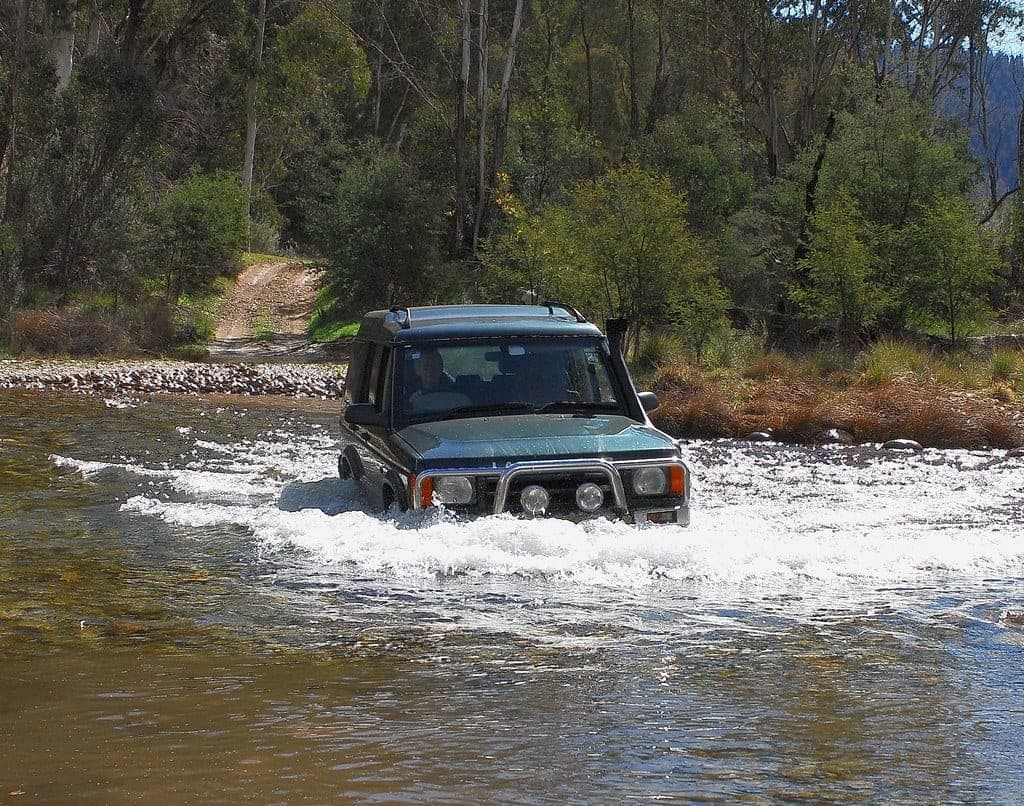
Snatch straps: how they work and how they kill people
Photo by Jack Heywood Photography · flickr · CC PDM 1.0
- Section
- Gear
- Category
- Recovery
- Read
- 5 min
- Updated
- 27 Aug 2026
Kinetic recovery explained, the rated points and shackles it depends on, and why this is the one piece of gear that has to be treated seriously.
A snatch strap is the most effective way to recover a badly bogged vehicle without a winch, and it is the piece of recovery gear that has killed people in this country. Both of those things are true because of the same property.
Kinetic recovery, explained
A snatch strap is deliberately elastic. Under load it stretches, commonly around 20 percent of its length, and in stretching it stores energy in exactly the way a drawn bow does.
The recovery vehicle takes up the slack, then drives away with steady momentum. The strap stretches, stores energy, then contracts and releases that energy into the stuck vehicle as a sustained pull rather than a jerk. That elastic pull is far more effective at breaking suction and rolling a bogged vehicle out than a static tow rope, which simply loads up and stops.
That is the whole benefit. And the stored energy is the whole hazard, because energy in a stretched strap has to go somewhere if the system fails.
What failure looks like
If any component in the chain fails while the strap is under tension, the strap contracts violently and throws whatever is attached to it.
The mechanism people underestimate is that the strap does not simply drop. A steel bow shackle at the end of a contracting strap travels fast enough to go through a windscreen and through the person behind it. Fatalities in Australia have involved tow balls, shackles and recovery points that were never rated for the load.
The distances involved are larger than people expect. Bystanders standing well off to the side have been hit. There is no reliable safe angle, only safe distance.
The rules that are not optional
Rated recovery points at both ends. A rated recovery point is engineered and certified for recovery loads and bolted to the chassis. It is not the same as a tie-down lug, which exists to strap the vehicle to a ship or a truck and is not rated for shock loading. Using a tie-down as a recovery point is a common and serious mistake.
Know where your rated points are before you need them, not while standing in mud.
Never a tow ball. This bears repeating because it keeps happening. A tow ball is held on by one nut and weighs a couple of kilograms. Under shock load it detaches and becomes a projectile with lethal energy.
Correctly rated shackles, or better, soft shackles. A soft shackle is synthetic rope, it carries very high loads, it weighs almost nothing, and if it fails there is no mass to throw. For most touring recoveries this is simply the better choice.
A dampener over the strap. A recovery dampener, or at a pinch a heavy blanket or a jacket, laid across the middle of the strap. If the strap lets go, the weight kills much of its whip and drags it to the ground rather than letting it fly. Cheap, and it works.
Everyone well clear. Nobody outside the two vehicles, and further away than feels necessary. Spectators standing to the side to film is how bystanders get hurt.
Never join two straps with a shackle. If you must extend, the correct method is a reef knot with a rolled-up magazine or similar through it, which absorbs energy and can be undone afterwards. A steel shackle in the middle of a stretched strap is a missile with a guaranteed launch point.
Sizing it
The usual guidance is a minimum breaking strength of roughly two to three times the vehicle's gross vehicle mass.
Both directions matter. Under-rated, it breaks under load, which is the failure everyone imagines. Over-rated is also wrong and less obvious: a strap that is too strong for the vehicle does not stretch enough, so instead of absorbing energy it transmits shock straight into the chassis and the recovery points. People have torn recovery points off vehicles this way.
Match the strap to the lighter of the two vehicles involved.
Inspecting it
Strap ratings degrade invisibly, which is why inspection matters more here than with most gear.
Look for cuts and abrasion, particularly at the eyes. Check for stiffness, which indicates the fibres have been damaged or contaminated. Look for chemical staining, since diesel and oil weaken webbing. Watch for UV damage, which fades and chalks the surface.
Recovery straps also fatigue with use. A strap that has done many hard recoveries has stretched permanently and does not perform the way it did new. If it no longer returns to its original length, retire it.
Wash straps in fresh water after use in mud or salt water, and dry them before storing.
When not to use one
When boards will do. Most sand boggings are resolved with a shovel, lower tyre pressures and recovery boards, none of which can hurt anyone. Reach for those first, every time.
When the vehicle is high-centred. If the weight is resting on the chassis rather than the wheels, snatching drags the vehicle across whatever it is sitting on and can bend things badly. Dig first.
When the stuck vehicle has no rated points. No safe recovery is possible. Find another method.
When you are not sure. Practising this on a quiet afternoon with someone experienced is worth more than reading about it, and the moment to learn is not at dusk with a rising tide.
Where it fits
A snatch strap belongs in a touring kit. It also belongs behind the shovel, the compressor and the boards in the order you reach for things, because those three solve most situations with no risk at all.
The full kit and the reasoning behind it is in the recovery kit that earns its space.
Common questions
- How does a snatch strap work?
- It is elastic. The strap stretches under load, storing energy as the recovery vehicle drives away, then releases that energy to pull the stuck vehicle out. That stored energy is what makes it effective at freeing a badly bogged vehicle, and it is also exactly what makes a failure dangerous.
- Why are snatch straps dangerous?
- Because they store a large amount of energy under tension. If a recovery point, shackle or the strap itself fails, that energy releases instantly and throws the failed component and the strap at high speed. People have been killed by tow balls and shackles launched during snatch recoveries, including bystanders standing well to the side.
- Can you use a tow ball for a snatch recovery?
- No. Never. A tow ball is designed for a steady pulling load in one direction, not the shock load of a kinetic recovery, and it is a heavy lump of steel attached by a single nut. Tow balls detaching during snatch recoveries are a well-documented cause of fatalities in Australia.
- What size snatch strap do I need?
- The commonly used guidance is a minimum breaking strength around two to three times the vehicle's gross vehicle mass. Too weak and it breaks. Too strong is also wrong, because an over-rated strap stretches less, transferring more shock into the vehicles and their recovery points rather than absorbing it.
- Are soft shackles safer than steel shackles?
- Yes, meaningfully. A soft shackle is made from synthetic rope, weighs a fraction of a steel bow shackle, and if something fails it has very little mass to throw. A steel shackle that lets go under load becomes a projectile. Soft shackles are the sensible default for most touring recoveries.
Related
Gear4 min read
The recovery kit that earns its space
What to carry, what to leave behind, and the two items that hurt people every year.
 Gear
5 min read
Recovery boards: how they work and how to use them properly
The safest recovery tool in the kit, why they fail when people get impatient, and what separates a board that lasts from one that shreds.
 Guides
5 min read
UHF radio channels in Australia: the ones that matter
Which channels are legally reserved, which ones convoys and road trains actually use, and why a UHF is not a substitute for a satellite messenger.