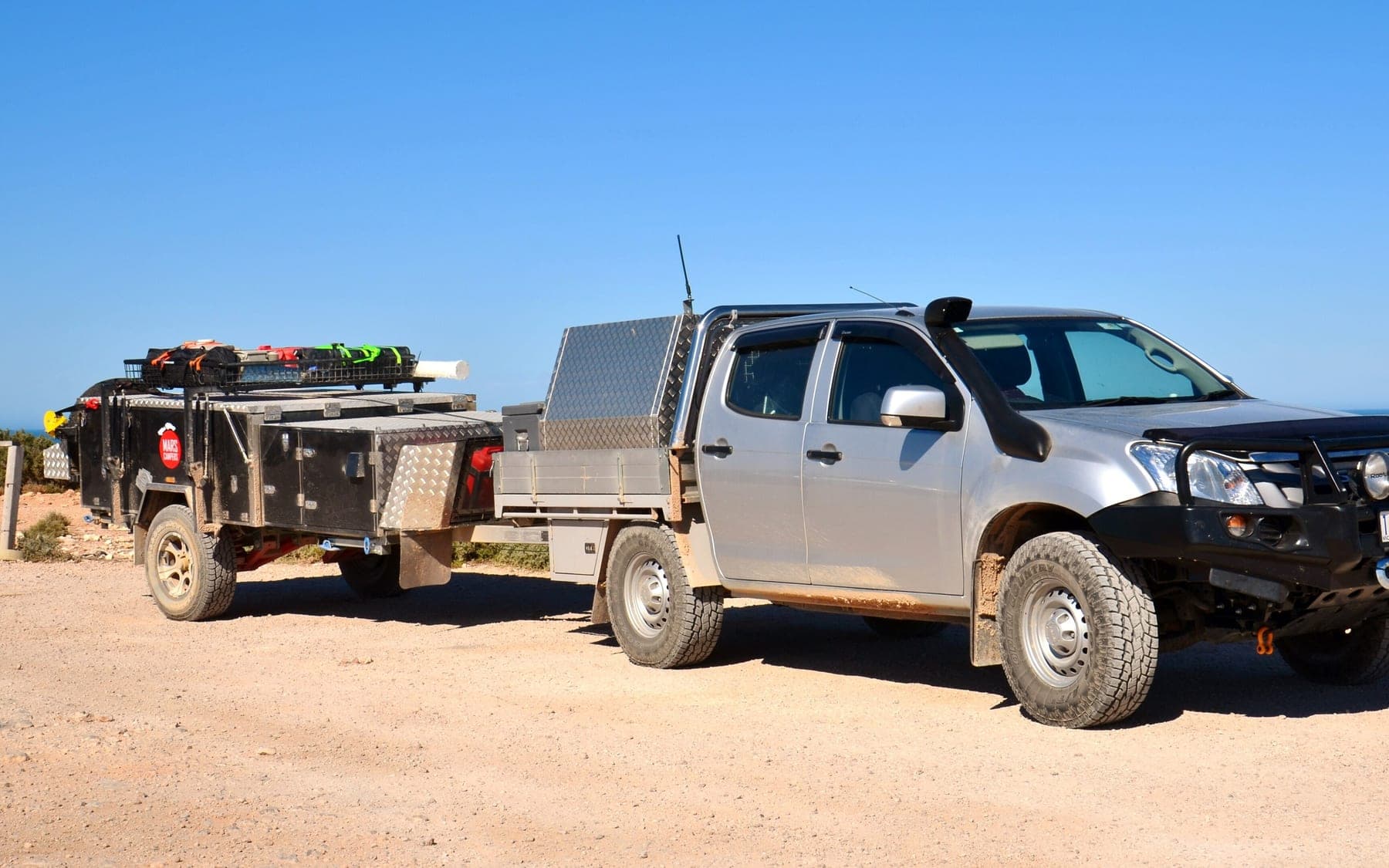
Free camping in South Australia
Photo by Bahnfrend · Wikimedia Commons · CC BY-SA 4.0
- Section
- Guides
- Category
- Planning
- Read
- 4 min
- Updated
- 27 Aug 2026
Desert parks with a separate pass, a long empty coastline, and the state where the outback tracks start.
South Australia is where the outback tracks begin, and camping in this state divides fairly cleanly between the accessible south and the remote north.
The three pass systems
South Australia runs more separate systems than most states, and getting them straight before you leave saves trouble.
Standard park entry and camping fees apply at most national and conservation parks. Camping is generally booked online and paid per site or per person.
The Desert Parks Pass is a separate annual pass covering the remote desert parks: the Simpson Desert, Witjira, the Innamincka and Strzelecki regions and others. It covers both entry and camping in those parks and is required rather than optional.
It also comes with a set of handbooks and maps that are substantially better than most commercial equivalents, which makes it worth having for the planning material alone if you are heading north.
Council and Crown land camping is the free tier: rest areas along the highways, council-provided sites in and near towns, and some bush camping on Crown land.
Where the free camping is
The Eyre Peninsula has an excellent run of low-cost and free coastal camping, much of it managed by councils, and it is quieter than the equivalent coastline in other states.
The Yorke Peninsula is similar and closer to Adelaide.
The Murray River frontage holds extensive camping along the river reserves.
The Flinders Ranges mixes national park camping, which is paid and booked, with station stays and bush camping on pastoral land where permitted. Ikara-Flinders Ranges National Park covers the park side.
The Limestone Coast in the south-east has forest reserves and council sites.
The far north is Desert Parks Pass country and is a different proposition entirely.
Station stays
Worth calling out because South Australia has a lot of them and they are frequently overlooked.
Working pastoral stations across the mid-north and the outback open camping areas for a modest fee, often on a creek or beside a homestead, sometimes with a shower and a toilet. They are usually far better than a highway rest area, they cost very little, and the money goes to the people whose land you are on.
The Oodnadatta Track and the Flinders both have a good spread of them.
The outback tracks
South Australia is where the famous tracks start, and they demand a different level of preparation from the rest of the state.
The Oodnadatta Track runs from Marree to Marla, and is covered in detail in the Oodnadatta Track.
The Strzelecki Track runs north-east toward Innamincka.
The Birdsville Track runs north from Marree into Queensland.
The Simpson Desert crossing is the serious one, requiring the Desert Parks Pass, dune-driving experience, sand flags and genuine remote-travel preparation.
All of these close after rain, and driving a closed outback road in South Australia attracts substantial fines as well as doing real damage to the surface. Road condition reports are published and are the authoritative source.
Season
April to October for anywhere north of the Flinders. Summer in the north regularly exceeds 45 degrees, traffic on the remote tracks drops to almost nothing, and a breakdown becomes a serious situation rather than an inconvenience.
Winter nights in the outback and the Flinders drop below freezing regularly, which catches people who packed for the daytime. Camping mattresses covers the part of a sleep system that actually determines whether you are warm.
The southern coast and the peninsulas are comfortable for much more of the year, with summer being the peak season.
Practicalities
Water is the constraint in the north. Bore water along the tracks is often hot and heavily mineralised, and it is not a substitute for what you carry. See water: how much to carry.
Fuel gaps on the outback tracks run to several hundred kilometres, and roadhouses keep limited hours. Plan to reach the stop after the one you are aiming for.
Tyres take a beating on the gibber. Two spares is conventional advice on the northern tracks rather than cautious, and most corrugation damage is a speed problem first. See tyre pressures for sand, gravel and rock.
Coverage exists in the towns and essentially nowhere between them. A satellite messenger is standard equipment for anything north of the Flinders, as covered in communications beyond mobile coverage.
The honest summary
Work out which pass you need before you leave, because the Desert Parks Pass is separate and is not sold everywhere. Use station stays rather than rest areas where you can. Travel the north between April and October, and treat the tracks as remote travel rather than a long drive.
The general rules are in free camping in Australia: how it actually works.
Common questions
- Is free camping legal in South Australia?
- Yes, in designated areas. South Australia has a good spread of council-provided free and low-cost camping, roadside rest areas along the highways, and some free bush camping on Crown land and in forest reserves. National parks and conservation parks charge camping fees and most require booking.
- What is the Desert Parks Pass?
- It is a separate annual pass covering entry and camping in South Australia's remote desert parks, including the Simpson Desert, Witjira and Innamincka regions. It is distinct from the standard parks pass and is required for those areas. It comes with detailed handbooks and maps, which are genuinely useful for trip planning.
- Do you need a permit to drive the Oodnadatta Track?
- No permit is required for the track itself, which is a public road. Permits do apply if you leave it for certain areas, and the desert parks further north require the Desert Parks Pass. Some sections cross pastoral land where leaving the road is not permitted without permission.
- When should you visit outback South Australia?
- April to October. Summer temperatures regularly exceed 45 degrees in the north of the state, traffic on remote tracks is minimal, and a breakdown in those conditions is genuinely dangerous rather than inconvenient. Winter days are mild and nights are cold, often below freezing.
Related
 Guides
4 min read
Free camping in Australia: how it actually works
What counts as free camping, where it is genuinely permitted, and the rules that catch people out before the fine does.
 Guides
4 min read
Free camping in New South Wales
How NSW splits between paid national parks, free state forest and council rest areas, and why the park pass question matters more here than anywhere else.
 Guides
4 min read
Free camping in Queensland
The state with the most generous council camping and the strictest national park booking system, plus the crocodile line that changes how you camp.